.webp)



Durability of Ready-Mix Concrete vs. Hand Mix Concret
Home case-studies Durability of Ready-Mix Concrete vs. Hand Mix Concret
Case Studies Dec 20, 2025
Durability of Ready-Mix Concrete vs. Hand Mix Concret
By Udayasiri Bandara, Director QA/QC – Senarath Group | December 2025
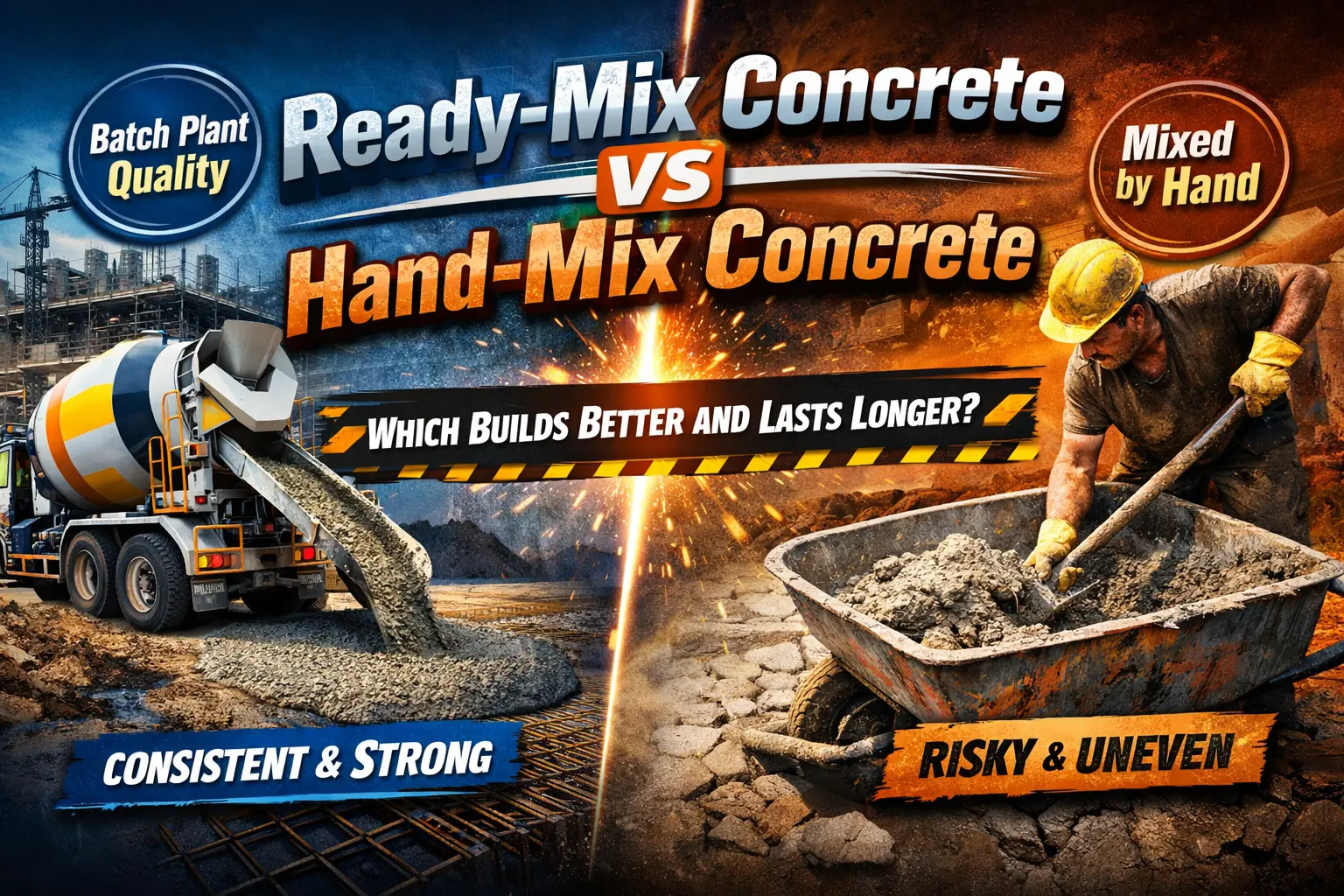
Which one truly performs better on real construction sites?
Concrete performance is not decided only by formulas or lab tests. In real projects, durability depends on how concrete behaves during placing, curing, weather exposure, and long-term usage. This is where the difference between ready-mix concrete and hand-mix concrete becomes clear.
Instead of focusing on theory, let’s look at what actually happens on site.
What really affects concrete durability in practice?
On construction sites, durability is influenced by four main factors:
- Consistency of the mix across pours
- Speed and accuracy of placement
- Resistance to cracks, water, and surface damage
- Ability to maintain strength over time without frequent repairs
Concrete that performs well in these areas lasts longer and costs less in maintenance.
Ready-mix concrete: designed for real-world reliability
Ready-mix concrete is produced in batching plants where materials are controlled, measured, and mixed under stable conditions. This gives it a major advantage on active construction sites.
Why ready-mix performs better in real conditions
- Same quality in every load
Each truck delivers concrete with the same consistency. This is critical for slabs, columns, beams, and foundations where uneven strength can cause cracks later. - Faster placement, less interruption
Concrete arrives ready to pour. This reduces delays, cold joints, and on-site improvisation. - Better surface finish and compaction
Consistent workability makes vibration and finishing easier, leading to fewer honeycombs and surface defects. - Stronger resistance to weather and moisture
Dense concrete structure slows water penetration, which reduces corrosion risk in reinforcement.
In long-term projects like buildings, pavements, and industrial floors, these advantages directly translate into durability.
Hand-mix concrete: workable, but with limitations
Hand-mix concrete is often used for small or urgent jobs. While it can serve basic needs, durability is harder to control.
Common site-level challenges
- Mix changes from batch to batch
Small variations in sand, aggregate, or water quickly affect strength and performance. - Higher chance of overwatering
To make mixing easier, extra water is often added, which weakens the concrete and increases cracking. - Uneven mixing and compaction
Manual mixing cannot always achieve uniform distribution of materials. - Faster surface wear
Hand-mix concrete is more prone to dusting, surface peeling, and early deterioration.
For non-structural work or temporary repairs, hand-mix may be acceptable. For long-term durability, it often falls short.
Cost comparison: short-term saving vs long-term expense
At first glance, hand-mix concrete looks cheaper. However, durability changes the real cost equation.
- Repairs due to cracks or surface failure
- Water leakage and reinforcement corrosion
- Shorter service life and early replacement
Ready-mix concrete may cost slightly more upfront, but it significantly reduces these long-term expenses.
Which option should you choose?
Choose ready-mix concrete when:
- Structural strength and lifespan matter
- Project scale is medium to large
- Quality consistency is critical
- You want lower maintenance over time
Choose hand-mix concrete when:
- The work is very small or temporary
- Structural performance is not critical
- Budget is extremely limited
Final takeaway
Durability is not just about how concrete is mixed. It is about how reliably it performs over years of use. In real construction environments, ready-mix concrete consistently proves to be the stronger, safer, and more economical choice over time.
If your project is built to last, the method of concrete supply should be chosen with long-term performance in mind.
